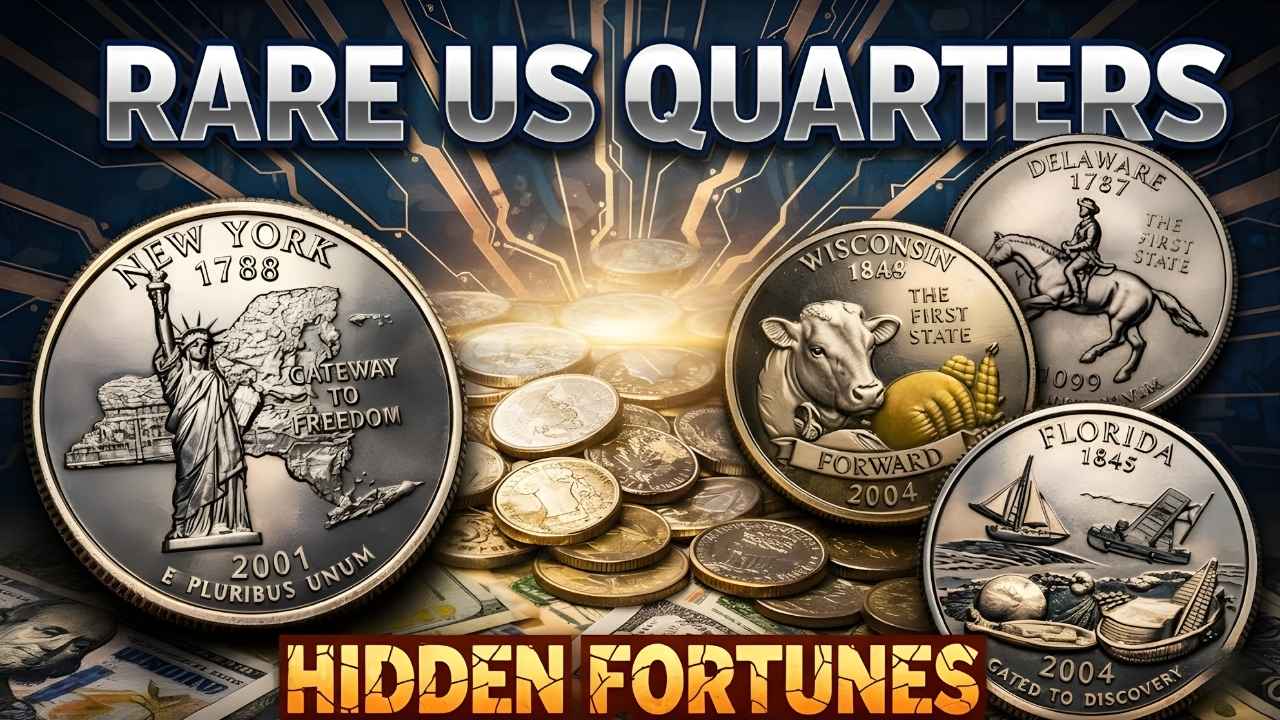
The 50 State Quarters Program, issued by the United States Mint from 1999 to 2008, transformed everyday change into a nationwide collecting movement. Each design celebrated a different state, creating excitement that reached far beyond traditional coin collectors. Even in 2026, more than a decade after the final release, these quarters continue to attract attention from hobbyists and investors alike. While most remain common, certain pieces have carved out a strong presence in the collector market.
The program’s popularity helped introduce millions of Americans to coin collecting. Many people who started filling maps and folders during the early 2000s are now revisiting their collections, curious about whether any hidden treasures might be tucked inside.
Why Most State Quarters Are Only Worth Face Value
Billions of state quarters were produced during the program’s ten-year run. Because of this massive mintage, the vast majority of circulated examples are still worth just 25 cents. Even coins in uncirculated condition, taken straight from bank rolls, typically sell for modest premiums unless they are in exceptionally high grades.
Supply plays the biggest role here. When coins are easy to find, demand must be extremely strong to push prices higher. For common state quarters, availability remains high, keeping values steady and affordable for beginners building complete sets.
What Makes Certain State Quarters Valuable
Although most coins from the series are common, several factors can significantly boost value. Mint errors are among the most important. Doubled dies, off-center strikes, die cracks, and missing design elements often attract strong interest. Because these errors occur unintentionally and in smaller numbers, collectors actively search for them.

Condition is another major factor. Coins graded in Mint State 67 or higher by professional grading services can command surprising premiums, especially if they are well-preserved with sharp details and attractive luster. Proof coins, particularly silver proofs sold in collector sets, also carry additional value due to their limited production and precious metal content.
Demand completes the equation. Popular and well-known error varieties tend to see steady price support, especially when they are widely recognized within the hobby.
Rare State Quarter Errors Collectors Still Chase
One of the most famous varieties is the 2004 Wisconsin Extra Leaf quarter. A die gouge on the corn stalk design created what appears to be an extra leaf, either pointing up or down. Depending on condition, these coins can sell for hundreds or even thousands of dollars, particularly in high grades.
Another well-known example is the 1999 Delaware Spitting Horse quarter. A die crack running from the horse’s mouth gives the illusion that the horse is spitting. While not as rare as the Wisconsin variety, strong examples remain popular and command healthy premiums.
The 2005 Kansas “In God We Rust” quarter is another standout. Due to a filled die error, the “T” in “Trust” is missing, resulting in a humorous and highly collectible mistake. Coins with this error often sell for significantly more than face value, especially when clearly struck and well-preserved.
How Prices Have Changed Over the Last Decade
Since 2015, the state quarter market has matured. Online marketplaces have made it easier to buy and sell specific varieties, while third-party grading services have increased buyer confidence. Certified error coins in top condition have shown steady appreciation, particularly those already recognized as key varieties.
Common coins, however, have remained largely unchanged in value. The gap between ordinary pieces and rare examples has become more pronounced. Collectors who identified and purchased notable errors early have generally seen consistent growth, especially when those coins were professionally graded.
Smart Collecting Strategies for 2026
For newcomers, assembling a full set of circulated quarters remains an affordable and enjoyable goal. Higher-end collectors often focus on upgrading their sets with proof versions or seeking the finest certified examples available.
Careful examination is essential. Many valuable errors are subtle and can be overlooked. Using magnification and comparing suspected varieties to verified examples can prevent costly mistakes. When dealing with higher-value coins, professional authentication is strongly recommended to ensure legitimacy and accurate grading.
Patience also pays off. The state quarter series is no longer new, but interest remains steady. As older collections resurface and fresh collectors enter the hobby, certain varieties may continue to strengthen in value over time.
Final Thoughts
The 50 State Quarters series remains one of the most recognizable modern coin programs in American history. While most pieces are still worth face value, select errors and high-grade examples continue to attract serious attention in 2026. For many collectors, the excitement lies not just in potential profits but in the thrill of examining everyday change for something extraordinary. With knowledge, careful observation, and a bit of luck, even a simple quarter can turn into a rewarding discovery.