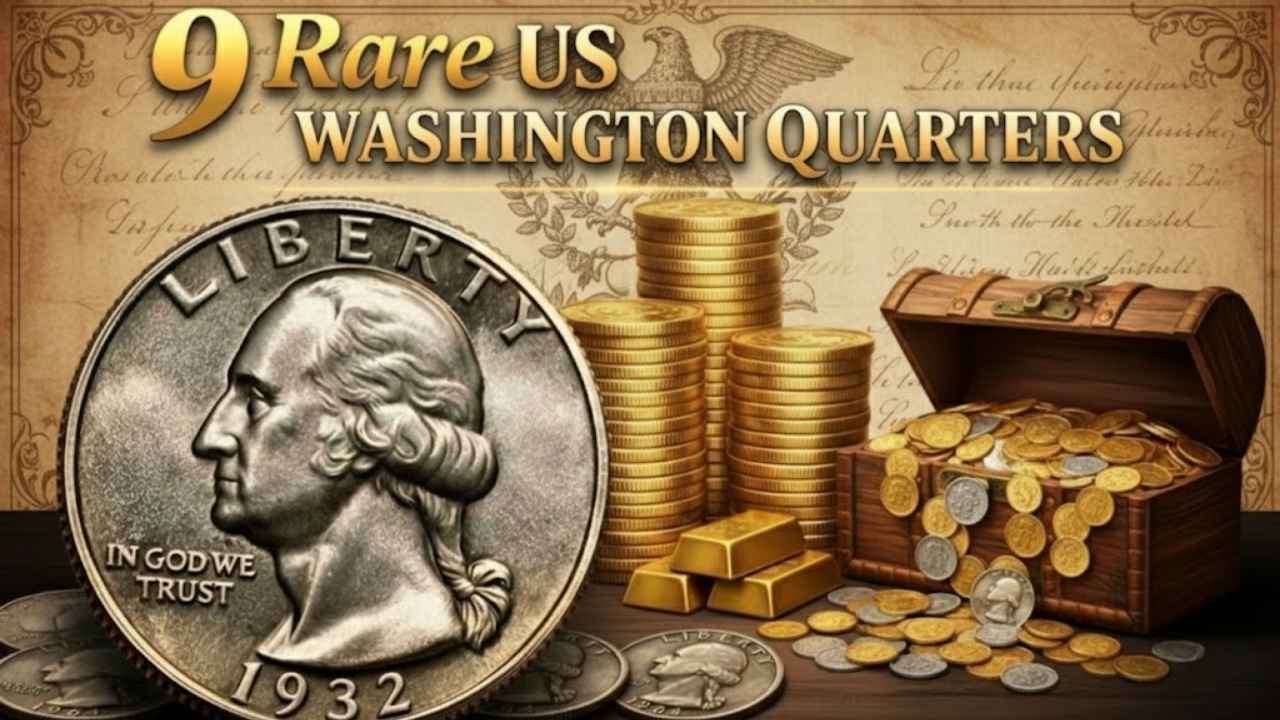
For most people, a quarter is just spare change, but certain issues have become prized collectibles worth tens of thousands of dollars. Originally introduced in 1932 to honor George Washington, the Washington quarter was meant as a one-year commemorative. Instead, it became a permanent fixture of United States coinage. Over time, billions were struck, yet a handful of scarce varieties have risen to legendary status because of low mintages, minting errors, or remarkable preservation.
Why Certain Quarters Are Worth So Much
Not every old coin is valuable, but a few key traits can dramatically increase worth. Scarcity is the biggest factor. Coins produced in limited numbers or those that didn’t survive in high condition often command premium prices. Errors also play a major role. Mistakes during production create unusual features that collectors find fascinating. When rarity, condition, and historical appeal combine, values can climb into five-figure territory or higher.
The Famous Overmintmark Mistakes
Among the most talked-about rarities are the 1950 overmintmark quarters. These coins were created when mint workers reused dies and accidentally stamped one mint mark over another. Some show a D layered over an S, while others display the reverse. These overlapping letters are visible under magnification and instantly distinguish them from normal issues. Top-grade examples in near-perfect condition have sold for more than $60,000, largely because so few escaped circulation without scratches.
The Legendary First-Year Keys
Two coins stand at the center of the series: the 1932-D and 1932-S quarters. Produced at the Denver Mint and San Francisco Mint during the depths of the Great Depression, their mintages were unusually low. As a result, collectors consider them essential pieces for completing a full set. Even heavily worn examples can be worth hundreds, while sharply preserved specimens may exceed $50,000 at auction.
Doubled Dies and Wartime Curiosities
Several Washington quarters are prized because of doubled die errors, which occur when the design is impressed more than once in slightly different positions. This effect creates a visible doubling of letters or details. Examples from the 1930s and 1940s show strong doubling in inscriptions or on Washington’s portrait. Because these errors are easy to spot yet rare to find, they have become favorites among specialists seeking unusual varieties.
The Mystery of the Foreign Planchet Strike
One of the strangest rarities in the series is a proof quarter struck on a Canadian coin blank. Somehow a foreign planchet found its way into a U.S. press, producing a coin with subtle traces of another design beneath the surface. Pieces like this fascinate collectors because they reveal unexpected moments in mint history. Surviving examples have sold for tens of thousands of dollars thanks to their uniqueness and the unanswered questions surrounding their creation.
Why Collectors Are Paying Attention Now
Interest in historic coinage has grown steadily, and recent commemorations have encouraged people to examine their change more closely. As demand rises, so do auction prices, especially for coins authenticated and graded by professional services such as Professional Coin Grading Service and Numismatic Guaranty Company. Certified coins give buyers confidence in authenticity and condition, which helps sustain strong market values.
How to Protect Valuable Finds
Anyone who discovers an unusual quarter should handle it carefully. Cleaning a coin can damage its surface and reduce its value dramatically. Collectors recommend storing pieces in protective holders that prevent scratches, moisture, and chemical exposure. Proper preservation ensures that a rare find retains both its appearance and its market appeal for years to come.
Final Thoughts
The Washington quarter series proves that extraordinary value can hide in ordinary places. While most examples remain everyday coins, a select group stands out because of rarity, errors, or exceptional condition. For collectors, the excitement lies in the search. A quick glance at a coin might reveal nothing unusual, but a closer look could uncover a small metallic treasure with a remarkable story and a surprisingly high price tag.