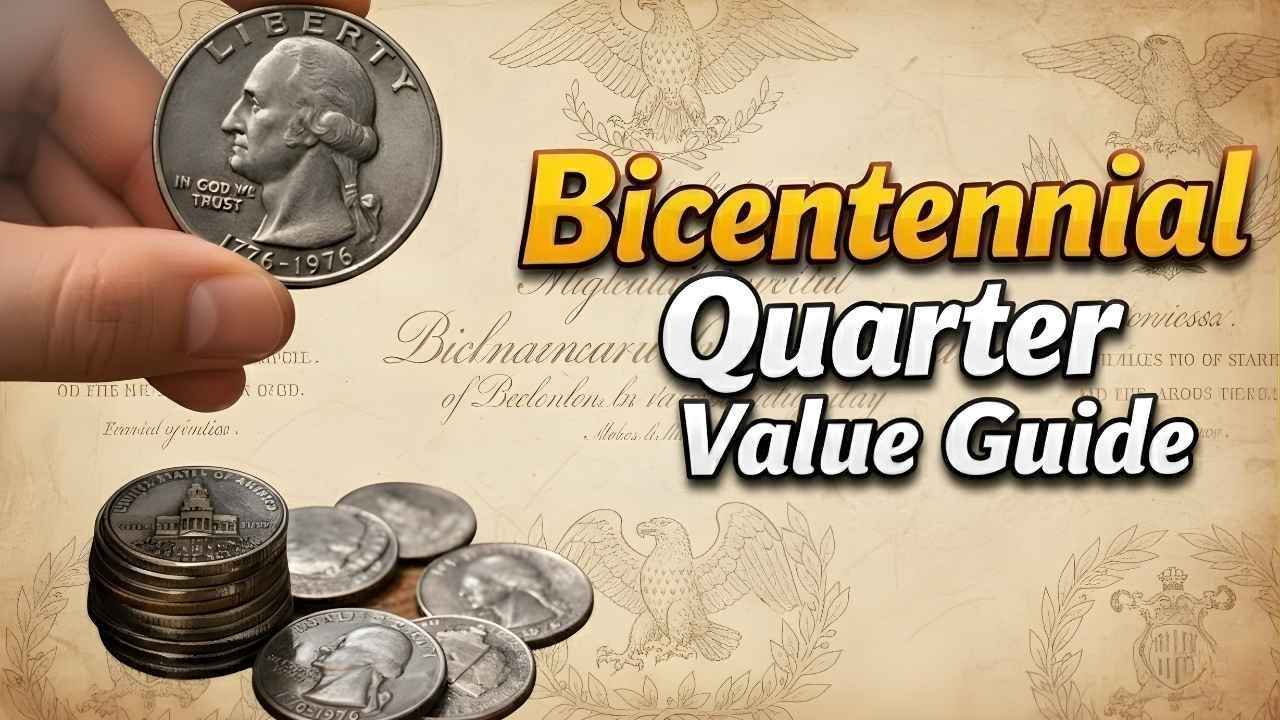
The 1776–1976 Bicentennial Quarter was issued to celebrate 200 years of American independence, and decades later it remains one of the most recognized modern coins. Instead of the traditional eagle reverse, the design features a colonial drummer and torch encircled by thirteen stars, symbolizing the original colonies of the United States. Because millions were struck for circulation, most examples still trade at face value. Yet certain varieties and conditions can transform an ordinary-looking coin into a collector prize worth far more than twenty-five cents.
Understanding the Two Main Types
Not all Bicentennial quarters were made the same way. The majority were produced with standard copper-nickel clad composition at facilities such as the Philadelphia Mint and Denver Mint. These are the coins most people encounter in pocket change today. However, a smaller number were specially struck in 40 percent silver for collectors at the San Francisco Mint. Those silver versions are scarcer and usually more desirable, particularly if they remain in pristine condition.
Simple Ways to Tell Silver From Clad
Collectors often start by checking the mint mark. A small “S” indicates San Francisco production, which may signal a silver issue, though some proof coins from that mint were still clad. Another quick method is the edge test. A clad quarter shows a visible copper stripe along the edge, while a silver example appears uniformly silvery. Weight can also help: clad pieces average about 5.67 grams, while silver ones are slightly heavier at roughly 5.75 grams. These small differences can mean a big change in value.
Typical Values in Today’s Market
Most circulated clad Bicentennial quarters are worth only their denomination or slightly more, often selling for between twenty-five cents and a dollar depending on condition. Silver versions, especially uncirculated ones, generally command stronger prices and may range from around ten to fifty dollars. In rare cases where a coin survives in near-perfect mint condition, values can climb dramatically into the thousands because top-grade examples are difficult to find.
Error Coins That Command Premium Prices
Minting mistakes are among the biggest drivers of value for modern coins. One of the most sought-after varieties is the doubled die obverse, where design elements appear duplicated due to a misaligned die. Strong examples can sell for hundreds or even thousands depending on clarity and preservation. Strike-through errors, caused when debris interferes with the striking process, can also bring solid premiums. Off-center strikes showing part of the design missing are popular as well, especially when the misalignment is dramatic but the date remains visible. Perhaps the most famous rarity is a proof coin lacking its expected mint mark, sometimes called a “No S” example, which can reach five-figure prices when authenticated.
Why Condition Is So Important
Even a common coin can become valuable if its condition is exceptional. Grading systems rank coins on a scale from 1 to 70, with higher numbers representing sharper detail, stronger luster, and fewer surface marks. A coin graded MS67 might sell for only a modest premium, but the same coin graded MS68 or higher can be worth exponentially more because so few survive in such flawless state. This dramatic jump illustrates why collectors carefully handle and store coins to preserve quality.
Getting Started With Your Own Search
Anyone curious about these quarters can begin by examining spare change or old coin jars. A magnifier with at least 10x power helps reveal doubling, unusual textures, or other irregularities. Checking mint marks and edges quickly separates ordinary pieces from potentially valuable ones. Proper storage is also essential. Protective holders made from safe materials prevent damage from moisture, air, and skin oils, all of which can lower value over time.
Final Thoughts
Most Bicentennial quarters will never be worth more than pocket change, but the thrill lies in the possibility that a rare variety or high-grade survivor could be hiding in plain sight. With a little knowledge and careful inspection, collectors and casual hobbyists alike can discover whether their commemorative quarter is simply a nostalgic keepsake or a surprisingly valuable find.