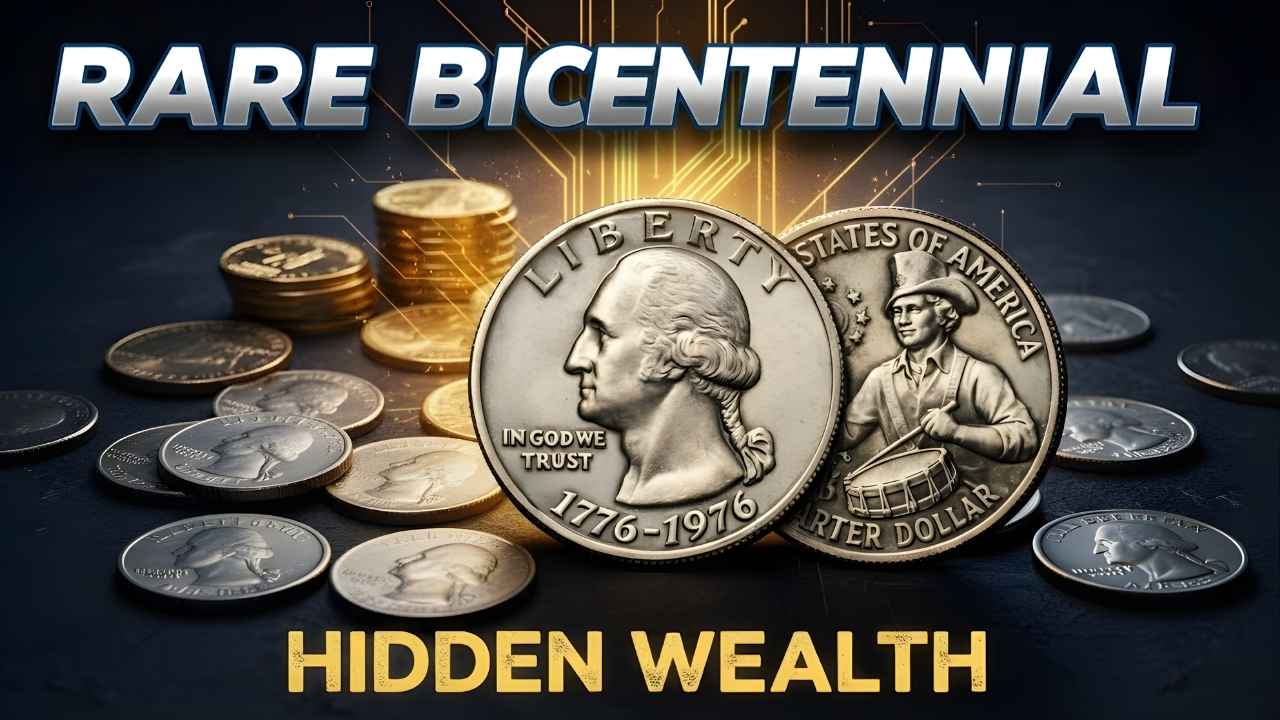
The Bicentennial Quarter, issued in 1975 and 1976 to honor America’s 200th year of independence, remains one of the most recognizable modern U.S. coins. Featuring a colonial drummer on the reverse and the dual date 1776–1976 on the obverse, the design by Jack L. Ahr stands apart from the traditional eagle reverse used on most Washington quarters. Although hundreds of millions were struck for circulation, a small percentage stand out for their rarity, composition, or unusual minting errors, making them highly desirable among collectors.
Most Bicentennial quarters found in circulation are standard copper-nickel clad coins and carry no premium beyond face value. However, certain versions, especially silver issues and well-preserved high-grade examples, can command significantly higher prices in today’s market.
The 40 Percent Silver Collector Editions
In addition to regular circulation coins, the United States Mint produced special 40 percent silver Bicentennial quarters specifically for collectors. These coins were never intended for everyday use and were sold in proof and uncirculated sets.
The 1976-S Silver Proof Quarter is among the most popular of these issues. With a mirror-like finish and sharp detail, proof versions are especially attractive when preserved in pristine condition. Depending on grade and certification, these coins commonly sell in the $10 to $50 range, with exceptional specimens reaching higher levels.
The 1976-S Silver Uncirculated Quarter, sometimes overlooked, can also bring solid premiums. While not as flashy as proofs, high-grade uncirculated examples are scarcer than many collectors realize. As silver prices fluctuate, the intrinsic metal value also provides a baseline that supports long-term demand.
Error Coins That Drive Up Prices
Mint errors are where Bicentennial quarters become truly exciting. Because of the coin’s massive production, most pieces are identical. When something unusual occurs during striking, collectors take notice.
Doubled die varieties, where lettering or design elements appear doubled, are particularly appealing. Strong doubling on the date or inscriptions can significantly increase value. Off-center strikes are another eye-catching error, with the design shifted noticeably away from the center. The more dramatic and well-preserved the misalignment, the higher the potential price.
Even more valuable are wrong planchet strikes or overstrikes. These rare mistakes occur when a quarter design is struck on a blank intended for another denomination. Such pieces are extremely scarce and can sell for hundreds or even thousands of dollars, depending on condition and documentation.
The Importance of Condition and Professional Grading
Condition plays a decisive role in determining market price. A circulated clad Bicentennial quarter may be worth only 25 cents, but the same coin in superb uncirculated condition can sell for much more. Coins graded MS-67 or higher are particularly scarce because relatively few were preserved carefully at the time of issue.
Professional grading services such as Professional Coin Grading Service and Numismatic Guaranty Company authenticate, grade, and encapsulate coins, providing confidence to buyers and sellers. Certified coins typically command stronger prices than raw, ungraded examples. For silver and error varieties especially, third-party certification often makes a significant difference in market value.
Current Market Price Ranges
For collectors evaluating their finds, understanding general price ranges is helpful. Circulated clad quarters remain face value in most cases. Uncirculated clad examples can sell for a few dollars, particularly if they display strong luster and minimal marks.
Silver proof and uncirculated coins generally range from $10 to $50, depending on grade and overall eye appeal. Error coins vary widely. Minor off-center strikes may bring modest premiums, while dramatic errors or rare doubled dies can reach into the hundreds. Exceptional wrong planchet pieces and top-pop graded coins may achieve even higher prices at auction.
Smart Strategies for Collectors
Collectors interested in Bicentennial quarters should consider searching old proof sets, inherited collections, and bank coin rolls. Silver issues are typically identified by their mint mark and slightly different edge appearance compared to clad coins.
Focusing on quality rather than quantity often produces better long-term results. High-grade certified coins, clearly defined errors, and well-documented silver pieces tend to perform more consistently in the marketplace. Keeping coins properly stored in protective holders also preserves their value over time.
Final Verdict
Bicentennial quarters may be common at first glance, but certain silver editions, high-grade examples, and rare mint errors have transformed ordinary pocket change into sought-after collectibles. Market prices depend heavily on rarity, condition, and collector demand, with standout pieces reaching impressive figures. Whether you are a seasoned numismatist or a curious beginner, examining these historic quarters more closely could uncover hidden value tied to one of America’s most celebrated anniversaries.